BIOMEDIX
Systems Trading Corporation

The cost to start a diagnostic laboratory in the Philippines depends on three decisions you make early: the DOH category you apply for, the tests you plan to offer, and how you choose to acquire your equipment. A small primary-category laboratory and a full tertiary laboratory can differ in startup budget by more than ten times.
Many first-time owners underestimate their laboratory startup cost because they budget only for the analyzers. In practice, your diagnostic lab setup cost also includes licensing, floor plan compliance, renovation, staff salaries, reagents, quality assurance, and enough working capital to survive the first few months before patient volume builds up.
This guide breaks down each cost category, shows indicative ranges for primary, secondary, and tertiary laboratories, and explains practical ways to lower your initial investment without compromising DOH compliance or test quality.
Note: All peso figures in this article are indicative planning ranges for 2026. Actual prices vary by location, brand, configuration, and supplier terms. Always request formal quotations before finalizing your budget.
| Laboratory category | Typical scope | Indicative total startup budget |
|---|---|---|
| Primary | CBC, blood typing, urinalysis, fecalysis, rapid tests, basic chemistry | ₱1.8M – ₱5M |
| Secondary | Primary tests plus electrolytes, liver enzymes, Gram stain, KOH, Pap smear | ₱3M – ₱9M |
| Tertiary | Secondary tests plus expanded chemistry, machine-based immunology, culture and sensitivity | ₱10M – ₱30M+ |
These totals include equipment, renovation, licensing, initial reagents, and three to six months of working capital. They do not include buying property or constructing a new building.
The wide ranges are intentional. The cost to start a diagnostic laboratory in the Philippines changes significantly depending on whether you buy new equipment outright, rent it, or use a reagent tie-up arrangement. We cover those options later in this guide.
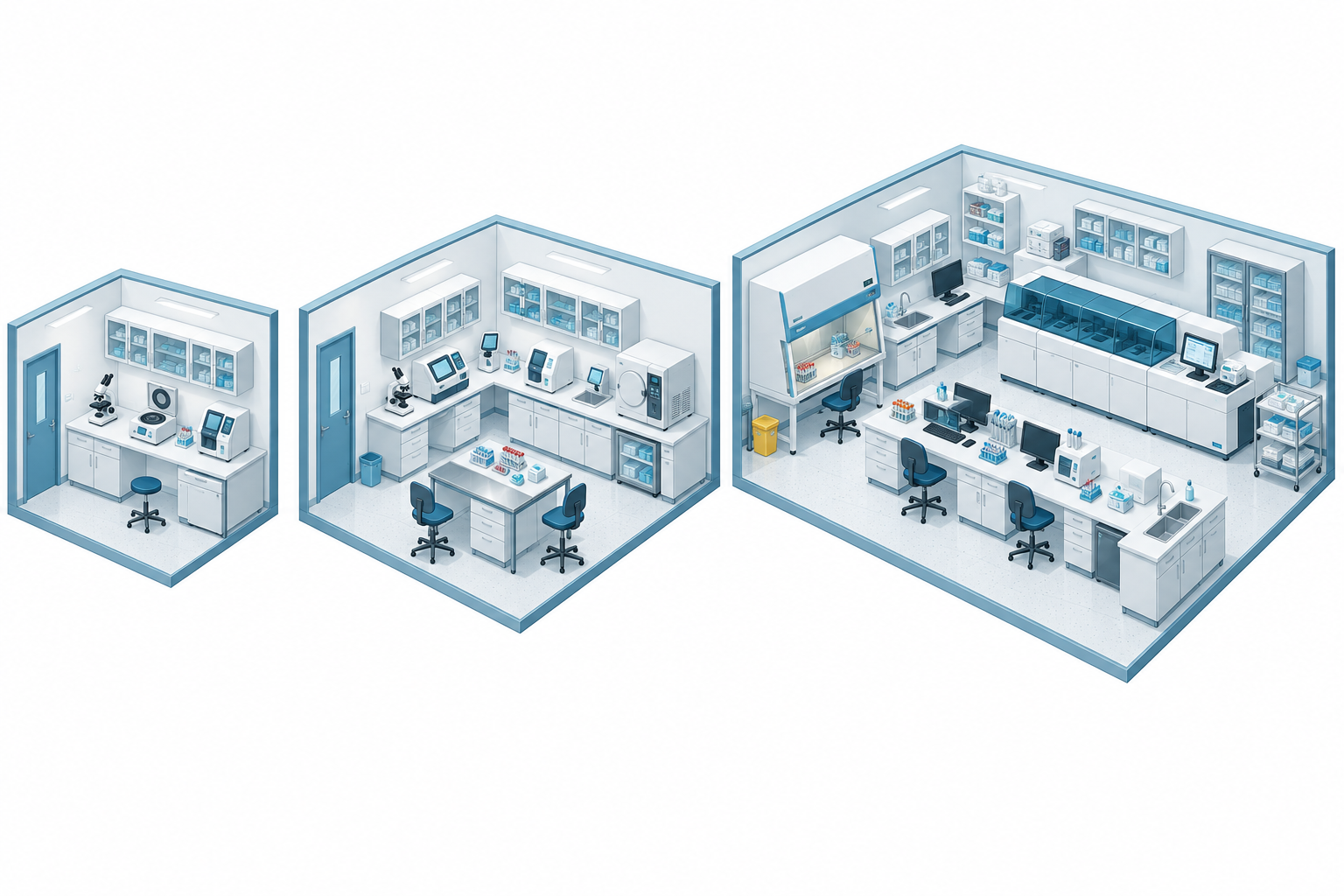
Your service capability determines the minimum tests you must offer, which in turn determines the equipment, personnel, and space you need. Every clinical laboratory must secure a DOH License to Operate (LTO) before it starts accepting patients.
The current rules are set by DOH Administrative Order No. 2021-0037, the New Rules and Regulations Governing the Regulation of Clinical Laboratories in the Philippines. It classifies general clinical laboratories into four service capability levels.
A primary laboratory provides routine services such as complete blood count, ABO and Rh typing, urinalysis, fecalysis, fecal occult blood test, rapid pregnancy test, rapid serology for dengue, syphilis, hepatitis B, and HIV screening, and basic chemistry such as blood sugar, lipid profile, creatinine, BUN, and uric acid.
Because basic chemistry is already part of the primary category, even the smallest laboratory needs a chemistry analyzer in addition to a hematology analyzer and microscope.
A secondary laboratory offers all primary services plus serum electrolytes, ALT, AST, Gram stain, KOH mount, and Pap smear. Hospital-based secondary laboratories also perform coagulation studies such as PT and aPTT.
A tertiary laboratory adds other clinical chemistry examinations, machine-based serological and immunological testing such as tumor markers and thyroid function tests, and aerobic and anaerobic culture and sensitivity. Hospital-based tertiary laboratories may also handle arterial blood gas testing.
A laboratory with limited service capability offers only one or two specialized tests, such as hormones, tumor markers, or DOH program-related tests. This route can work for specialty clinics, but it is not a full general laboratory.
Budget tip: Decide your category before you sign a lease, because it shapes your entire diagnostic lab setup cost. The category determines how much floor area you need, and your floor plan must pass DOH review before construction begins.
Before you can operate, you need to register your business and secure local and national permits. Typical requirements include:
Under AO 2021-0037, a DOH-PTC is required before building a new clinical laboratory and before renovating, expanding, or relocating an existing one. The LTO is valid for one year, so renewal is a recurring cost.
Government filing fees are relatively small compared with other startup expenses. The larger costs usually come from professional fees for architectural and engineering plans, notarization, and corrections after a failed assessment.
Skipping this step is expensive. Under the same order, operating without a PTC and LTO can result in a Cease-and-Desist Order and a ₱50,000 administrative penalty.
Indicative budget: ₱50,000 – ₱250,000, including professional fees for plans and documentation.
DOH planning and design guidelines go well beyond "a clean room with a counter." Your floor plan typically needs:
Construction details also add cost. The guidelines call for seamless, self-coving floors in the clinical working area, non-porous work counters, stainless steel sinks with gooseneck faucets, minimum corridor widths, fire-rated doors, and proper ventilation with exhaust directed outside. Tertiary laboratories need separate rooms for microbiology and histopathology.
Renting a space that already meets most of these requirements can save hundreds of thousands of pesos in renovation work.
Indicative budget:
Add two to three months of rent for deposits and advance payment.
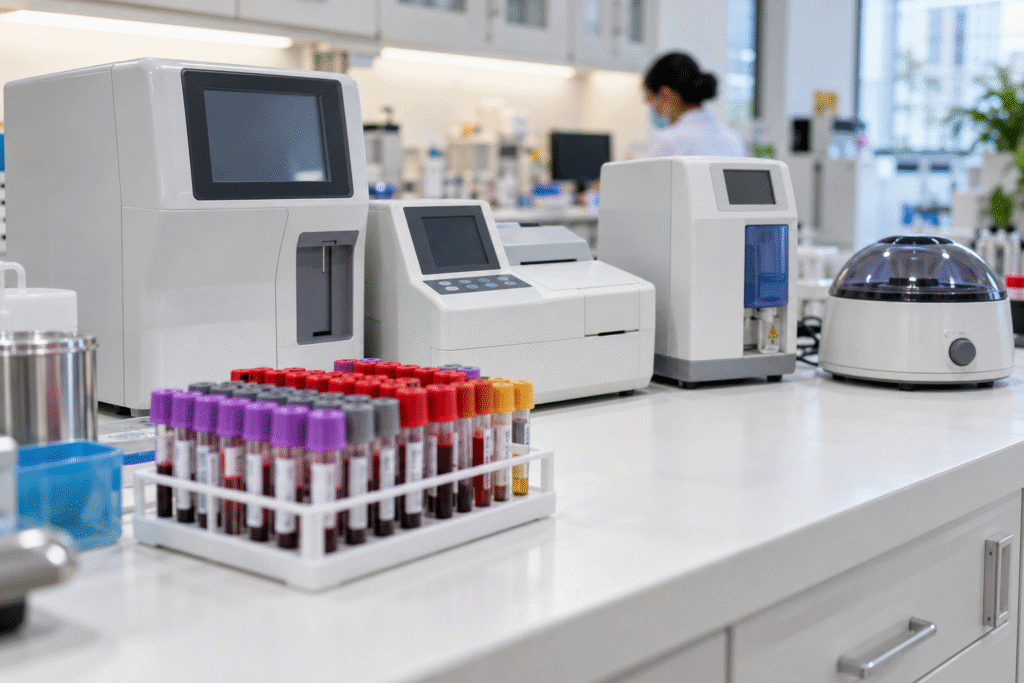
Equipment is usually the largest single item in your diagnostic lab setup cost. The table below shows indicative ranges for brand-new units.
| Equipment | Needed from | Indicative price range |
|---|---|---|
| Binocular microscope | Primary | ₱25,000 – ₱120,000 |
| Tabletop centrifuge | Primary | ₱15,000 – ₱80,000 |
| 3-part hematology analyzer | Primary | ₱350,000 – ₱800,000 |
| Semi-automated chemistry analyzer | Primary | ₱120,000 – ₱400,000 |
| Laboratory refrigerator | Primary | ₱40,000 – ₱150,000 |
| Electrolyte analyzer | Secondary | ₱250,000 – ₱600,000 |
| Semi-automated coagulation analyzer | Secondary (hospital-based) | ₱100,000 – ₱350,000 |
| Autoclave | Secondary | ₱60,000 – ₱300,000 |
| Incubator and drying oven | Secondary | ₱40,000 – ₱150,000 |
| Fully automated chemistry analyzer | Tertiary | ₱1.5M – ₱4M+ |
| Immunoassay analyzer | Tertiary | ₱1.5M – ₱5M+ |
| Class II biosafety cabinet | Tertiary | ₱350,000 – ₱900,000 |
For example, a startup laboratory might pair a compact chemistry system such as the BioSystems BTS Chemistry Analyzer with the BioSystems HA3 Hematology Analyzer. Laboratories moving into the secondary category often add an electrolyte system such as the Diestro 103AP Electrolyte Analyzer.
The level of automation is one of the biggest price drivers. Our comparison of fully automated vs semi-automated chemistry analyzers explains which option fits your expected daily test volume. If you are comparing hematology systems, read our guide on buying a hematology analyzer machine.
Remember that every machine, reagent, and test kit used in a licensed laboratory must be approved by the Philippine FDA.
Indicative equipment budget:
Your analyzers cannot run without reagents, calibrators, controls, test kits, blood collection tubes, needles, slides, and personal protective equipment. Plan for an opening inventory that covers at least one to two months of expected testing.
Reagent cost per test also affects profitability for the life of the analyzer. Ask suppliers for the cost per reportable result, not just the price per reagent kit.
Indicative opening inventory:
Staffing is your largest recurring expense, so it belongs in the cost to start a diagnostic laboratory in the Philippines from day one.
Indicative monthly payroll:
Every DOH-licensed laboratory must run an internal quality control program and participate in an External Quality Assessment Program (EQAP). You will pay for control materials and EQAP enrollment every year.
You also need a calibration, preventive maintenance, and repair program for every instrument, plus a contingency plan for equipment breakdowns. Our article on laboratory equipment maintenance explains why these programs protect both your results and your investment.
Many new laboratories also invest in a Laboratory Information System (LIS) for result encoding, releasing, and record keeping. See our laboratory management software guide for features to look for.
Indicative budget: ₱50,000 – ₱1M, depending on LIS choice and the number of instruments.
Working capital is the most overlooked part of the cost to start a diagnostic laboratory in the Philippines. New laboratories rarely reach target patient volume in the first month. Set aside three to six months of operating expenses to cover rent, payroll, utilities, reagents, and maintenance while you build doctor referrals, HMO accreditations, and corporate accounts.
Add a contingency of 10% to 15% for unexpected costs such as plan revisions, extra electrical work, or delayed permits.
| Cost item | Primary | Secondary | Tertiary |
|---|---|---|---|
| Registration, permits, DOH licensing | ₱50K – ₱250K | ₱80K – ₱250K | ₱150K – ₱300K |
| Renovation and fit-out | ₱400K – ₱1.2M | ₱800K – ₱2M | ₱2M – ₱6M |
| Rent deposits and advance | ₱100K – ₱300K | ₱150K – ₱400K | ₱300K – ₱800K |
| Equipment | ₱700K – ₱1.8M | ₱1.3M – ₱3.5M | ₱5M – ₱15M+ |
| Opening reagents and consumables | ₱100K – ₱300K | ₱200K – ₱500K | ₱600K – ₱2M |
| QA, maintenance, LIS | ₱50K – ₱300K | ₱100K – ₱500K | ₱400K – ₱1M |
| Working capital (3–6 months) | ₱450K – ₱900K | ₱600K – ₱1.5M | ₱1.5M – ₱4M |
| Indicative total | ₱1.8M – ₱5M | ₱3M – ₱9M | ₱10M – ₱30M+ |
Use this diagnostic lab setup cost table as a starting point for your business plan, then replace each range with actual quotations from contractors, suppliers, and your landlord.
Reducing your laboratory startup cost should never mean using unapproved reagents, skipping quality control, or opening before your license is issued. These strategies can reduce your upfront spend while keeping your laboratory compliant.
Many owners start as a primary or secondary laboratory, build patient volume, then apply for an upgrade once revenue supports the investment. Remember that adding services beyond your current service capability requires DOH approval, and major renovations require a new PTC.
A fully automated analyzer is efficient at high test volumes, but a semi-automated system may be enough for a new laboratory with modest daily volume. Buy for your realistic first-year volume, with a clear upgrade path.
Some suppliers offer equipment rental, reagent tie-up arrangements, or installment plans. At Biomedix, we offer all three, which can significantly reduce the cash you need on day one. Compare the total cost over three to five years, not only the monthly payment.
A cheaper analyzer can become expensive if parts, reagents, or technicians are hard to get. Our guide on choosing a local distributor vs direct import for lab equipment explains how to compare the true total cost of ownership.
AO 2021-0037 allows laboratories to refer tests outside their service capability to another DOH-licensed laboratory under a Memorandum of Agreement. Referral lets you offer a wider menu without buying every machine on day one.
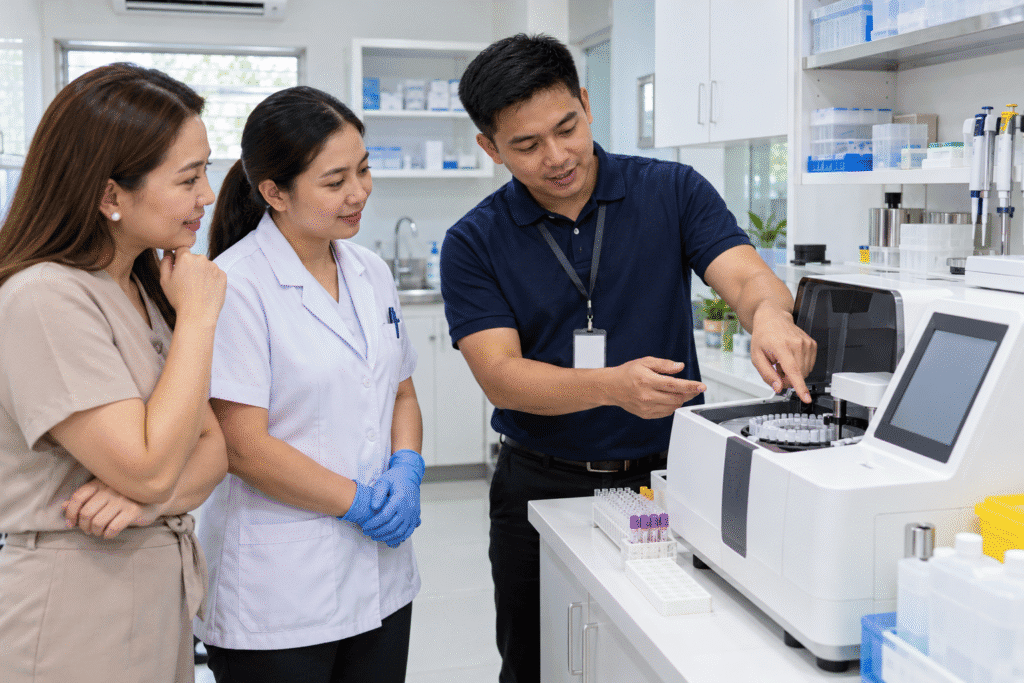
The cost to start a diagnostic laboratory in the Philippines is more manageable when your equipment supplier also helps with configuration, installation, staff training, and after-sales service.
At Biomedix, our sales team includes Service Engineers who are certified in the instrument brands we carry. As the exclusive Mindanao partner of BioSystems Reagents & Instruments, we help diagnostic centers, clinics, and hospitals choose the right equipment for their category, set up their laboratory, and keep it running.
Explore our laboratory equipment and supplies to start planning your setup.
How much is the cost to start a diagnostic laboratory in the Philippines?
Indicative budgets range from about ₱1.8M to ₱5M for a primary laboratory, ₱3M to ₱9M for a secondary laboratory, and ₱10M to ₱30M or more for a tertiary laboratory. The final amount depends on location, equipment choice, renovation needs, and financing terms.
What is the biggest part of the laboratory startup cost?
Equipment is usually the largest one-time cost, followed by renovation. Over time, staff salaries and reagents become the largest recurring expenses.
Do I need a pathologist to open a clinical laboratory?
Yes. Under DOH AO 2021-0037, a clinical laboratory must be headed by a certified pathologist who supervises its operations and makes documented visits.
Can I lower my diagnostic lab setup cost by renting equipment?
Yes. Equipment rental, reagent tie-up, and installment arrangements can reduce the cash you need upfront and spread your diagnostic lab setup cost over time. Compare the total long-term cost of each option before deciding.
How long does it take to get a DOH License to Operate?
The timeline depends on how complete your application is and how quickly you correct any deficiencies. Under AO 2021-0037, laboratories found non-compliant during assessment have 30 days to correct deficiencies before the application is denied.
The cost to start a diagnostic laboratory in the Philippines goes far beyond the price of an analyzer. A realistic budget covers licensing, a compliant floor plan, equipment, reagents, qualified staff, quality assurance, and enough working capital to reach steady patient volume.
Choose your DOH category first. Build your budget around it. Then compare suppliers based on total cost of ownership, local support, and flexible acquisition options.
A well-planned laboratory startup cost protects your investment and helps your laboratory deliver accurate results from the first day.
Ready to plan your laboratory setup?
Talk to the Biomedix team about your target category, expected test volume, and budget.