BIOMEDIX
Systems Trading Corporation
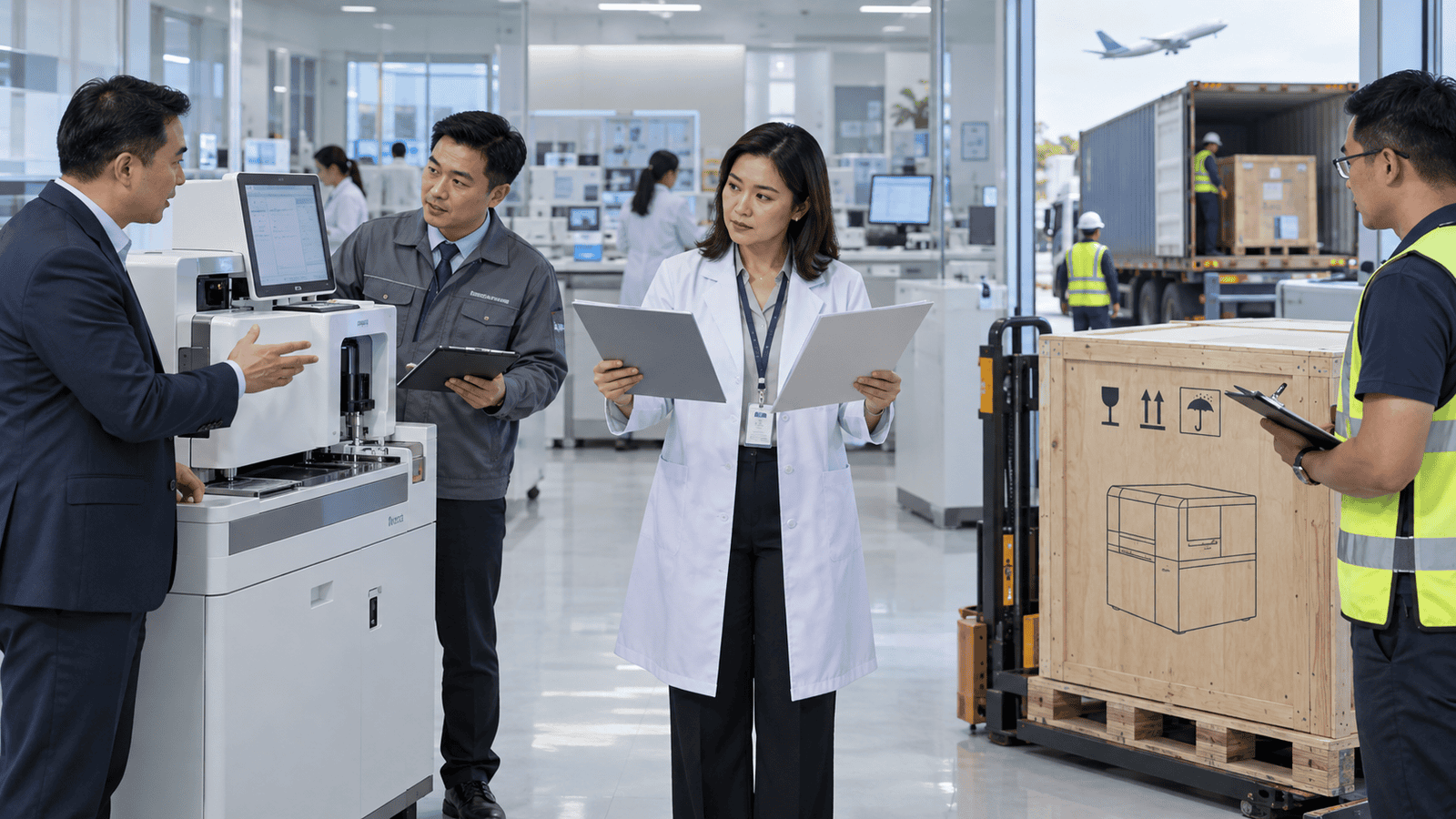
Choosing a local distributor vs direct import for lab equipment can affect much more than your initial purchase price. The source you choose can influence installation, regulatory requirements, warranty coverage, access to spare parts, staff training, and how quickly your laboratory can recover from equipment problems.
Direct import can look attractive when an overseas manufacturer or supplier offers a lower equipment price. A local distributor may quote more because local services and support are already part of the supply chain.
The lowest quoted price, however, is not always the lowest total cost.
This lab equipment buying guide compares both purchasing routes so laboratory owners and procurement teams in the Philippines can make a decision based on total cost, risk, and long-term laboratory operations.
| Factor | Local Distributor | Direct Import |
|---|---|---|
| Initial equipment price | May be higher | May be lower |
| Import processing | Usually handled by distributor | Buyer may assume more responsibility |
| Customs and logistics | Usually coordinated locally | Buyer must arrange or outsource |
| Installation | Often included or available | May require separate arrangements |
| Staff training | Often available locally | May be remote or limited |
| Warranty coordination | Local point of contact | May require overseas coordination |
| Spare parts | Potential local inventory | Often shipped internationally |
| Technical support | Local or regional technicians | Remote or manufacturer-based |
| Lead time | Faster if locally stocked | Depends on manufacturing and shipping |
| Cost predictability | Usually clearer | More variables affect final landed cost |
| Equipment selection | Limited to distributor portfolio | Wider international selection |
Neither route is automatically right for every laboratory. The better choice depends on the equipment, your technical resources, your timeline, and how much operational risk your laboratory can accept.
A local laboratory equipment distributor sources equipment from manufacturers and supplies it to laboratories within the Philippines.
The distributor may handle several parts of the transaction, including:
The level of service varies between suppliers. Laboratory buyers should confirm exactly what is included before signing a purchase agreement.
At Biomedix, for example, our sales team includes Service Engineers who are certified experts in the instrument brands we carry. We also provide equipment setup, installation, and technical support for diagnostic laboratories and hospitals.
Direct import usually means purchasing laboratory equipment from an overseas manufacturer, international distributor, or online supplier without buying through a Philippine distributor.
This approach can provide access to more models and, in some cases, a lower quoted equipment price.
The laboratory may also assume more responsibility for the transaction.
Depending on the product and purchasing arrangement, that can include:
Using a freight forwarder or customs broker can reduce the administrative work, but those services add to the final landed cost.
This is why the purchase invoice should never be the only figure used to compare the two options.
A practical lab equipment buying guide should start with the full cost of ownership, not the equipment price alone.
A direct-import quote may initially appear cheaper.
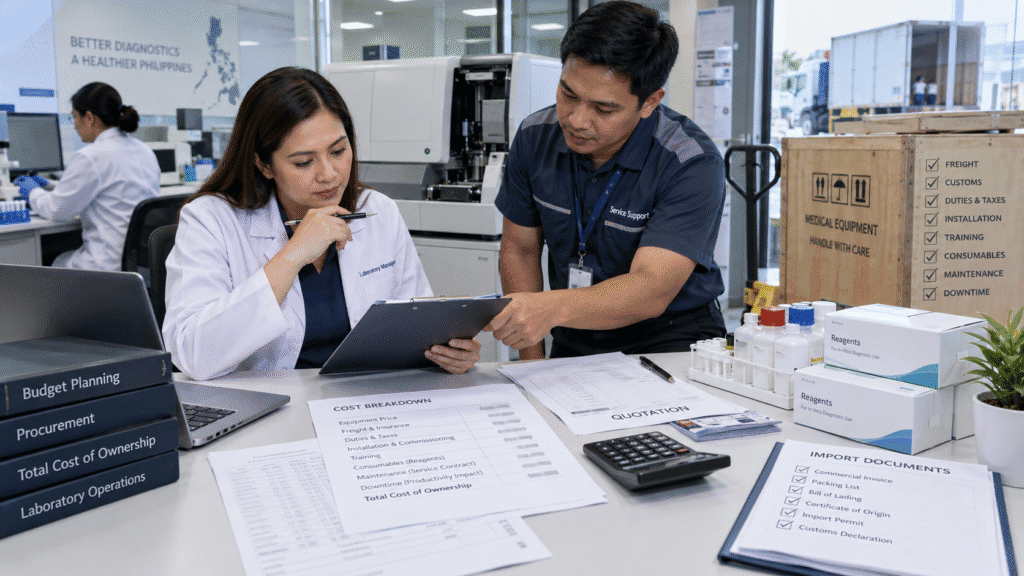
For example, an overseas seller may quote only the equipment, while a local supplier's quotation may already include freight, import processing, installation, training, and support.
A useful comparison should calculate the total cost of ownership.
Direct equipment costs
Import and delivery costs
Implementation costs
Operating costs
Risk costs
The Philippine Bureau of Customs states that imported goods are generally subject to duties and taxes unless an applicable exemption exists. Importers may also need the appropriate accreditation before conducting import transactions. Tariff rates vary according to product classification and other factors.
Equipment Price + Freight + Taxes + Installation + Training + Consumables + Maintenance + Downtime = Total Cost of Ownership
A quotation that looks cheaper can become more expensive after these costs are added.
Regulatory requirements deserve special attention before directly importing diagnostic equipment.
Any lab equipment buying guide for Philippine buyers should also account for import documentation, FDA requirements, and customs responsibilities before an order is placed.
The Philippines depends heavily on imported medical devices. A recent U.S. Commercial Service country guide reports that almost all medical devices used in the Philippine market are imported.
That does not mean every laboratory should import equipment independently.
The regulatory pathway depends on the type of equipment, device classification, intended use, and how the product will enter or be distributed in the Philippines.
For FDA-regulated medical devices, current rules include market authorization requirements based on device classification. The FDA states that Class A medical devices use the Certificate of Medical Device Notification process, while Class B, C, and D devices generally require a Certificate of Medical Device Registration under the applicable rules.
Importers and distributors of regulated medical devices may also be subject to FDA licensing requirements.
Diagnostic instruments, in vitro diagnostic products, research-use products, and other laboratory systems can have different requirements.
Before placing an international order, confirm:
Regulatory requirements can change, so confirm the current requirements with the Philippine FDA, Bureau of Customs, and qualified regulatory or customs professionals before importing.
A capable local distributor can remove much of this work from the laboratory's procurement team.
Buying equipment is only useful if your laboratory can place it into service.
Direct imports depend on several stages:
One delay can affect your planned opening date or laboratory expansion.
A local distributor may already have equipment or replacement units within the country. Even if the unit must still be imported, an experienced distributor should already understand the manufacturer's shipping requirements and local import process.
Ask every supplier for a realistic timeline from purchase order to operational use.
Do not settle for an estimated shipping date alone.
Modern laboratory analyzers need more than a power outlet.
Depending on the system, installation may involve:
Staff must also understand routine operation, daily maintenance, quality control, basic troubleshooting, and shutdown procedures.
Remote manufacturer training can work for simple instruments. More advanced chemistry, hematology, coagulation, and other automated systems may benefit from hands-on training.
Local technical support becomes especially valuable during the first weeks of operation because staff can address questions while they become familiar with the analyzer.
For laboratories comparing levels of automation, see Fully Automated vs Semi-Automated Chemistry Analyzers: Which Is Right for Your Lab?
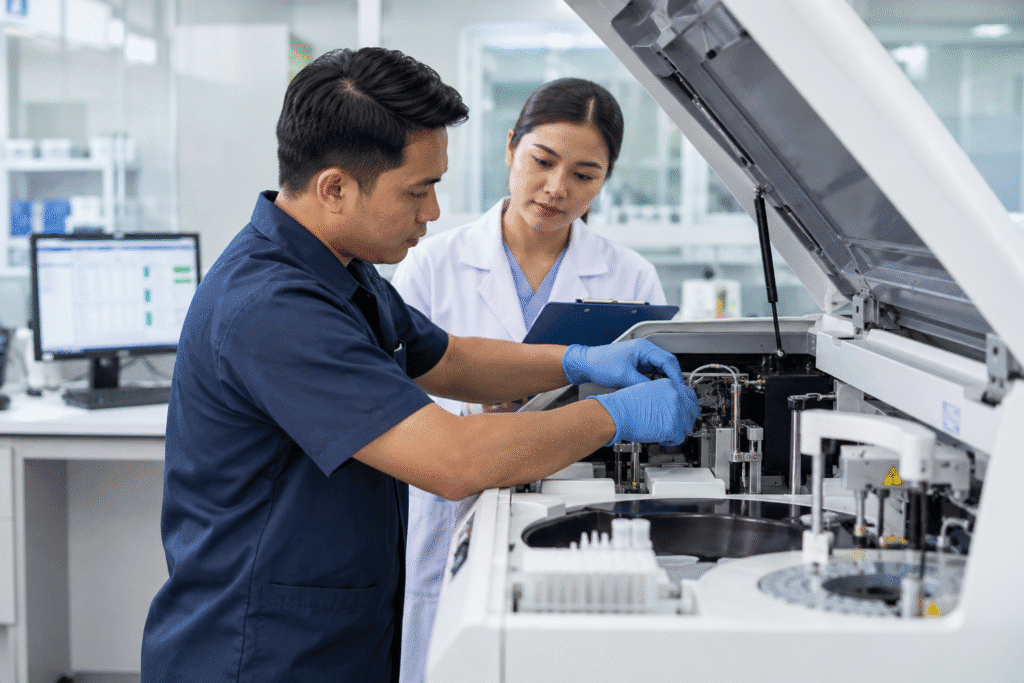
A laboratory analyzer earns its value while it is operating.
A reliable lab equipment buying guide should also evaluate warranty coverage, service response times, and access to qualified technicians before purchase.
A low purchase price loses its advantage if the equipment stops working and the laboratory cannot get technical assistance.
Before purchasing, ask:
Direct import can work well if your laboratory has experienced biomedical personnel, reliable manufacturer support, and a clear supply of replacement parts.
It carries greater risk if every technical problem requires international communication and overseas shipping.
Local support can shorten the chain between reporting a problem and getting the analyzer operational again.
Regular servicing also affects equipment reliability. Our guide on Laboratory Equipment Maintenance: Essential Tips for 2025 explains why preventive maintenance, calibration, service records, and qualified technicians should be part of your equipment plan.
The analyzer is only one part of a laboratory testing system.
A laboratory also needs a steady supply of:
Before direct importing an analyzer, determine whether these items are readily available in the Philippines.
A low-cost analyzer becomes difficult to operate if consumables must be ordered overseas every time stocks run low.
Long international lead times can also force laboratories to maintain larger inventories.
Local distributors with an established supply chain can provide an advantage by maintaining access to commonly needed reagents, consumables, and parts.
Reagent compatibility also affects analytical performance. Read Understanding the Role of Reagent Quality in Test Accuracy for more information about reagent selection, storage, and analyzer compatibility.
Direct importing may be reasonable if your laboratory:
Large institutions with established international procurement systems may have the resources to manage these responsibilities effectively.
A local distributor may provide greater value if your laboratory:
This is especially important for analyzers that support high daily test volumes.
For example, the BioSystems BA200 Clinical Chemistry Analyzer offers throughput of up to 200 tests per hour and uses barcoded dedicated reagents. A system operating at this level can become an important part of daily laboratory capacity, which makes installation, reagent supply, and technical support important purchasing considerations.
The local distributor vs direct import for lab equipment decision becomes especially important when your laboratory depends on fast technical support, steady reagent supply, and minimal downtime.
Use this lab equipment buying guide as a final check before choosing between a local distributor and direct import. Before choosing between a local distributor vs direct import for lab equipment, ask these questions:
The answers give you a more useful comparison than the purchase price alone.
A useful lab equipment buying guide should help you compare long-term operating value, not simply determine which supplier offers the lowest quotation.
The decision between local distributor vs direct import for lab equipment should focus on value across the full life of the equipment.
Direct import may provide a lower initial price or access to specialized products. For laboratories with strong import, engineering, and regulatory capabilities, it can be a practical option.
A reliable local distributor can provide another form of value: fewer parties to coordinate, clearer purchasing costs, local installation, staff training, easier warranty processing, access to consumables, and faster technical assistance.
At Biomedix, we support laboratories beyond the equipment purchase. Our team helps clients evaluate laboratory equipment, complete setup and installation, and maintain systems through qualified technical support.
Explore our laboratory equipment and supplies based on your laboratory's testing requirements.
Is importing laboratory equipment directly always cheaper?
No. Direct import may have a lower equipment price, but the final cost can include international freight, insurance, duties, VAT, customs services, installation, training, spare parts, and technical support. Compare the full landed and operational cost before deciding.
Can a Philippine laboratory import its own analyzer?
The answer depends on the equipment, regulatory classification, intended use, importer status, and applicable FDA and Bureau of Customs requirements. Confirm the current requirements before ordering. FDA-regulated medical devices and diagnostic products can require licenses or market authorization.
How can I check if a laboratory equipment distributor is reliable?
Ask about manufacturer authorization, FDA licenses where applicable, technical staff, installation history, warranty procedures, spare-parts availability, preventive maintenance, and response times. Request references from laboratories using similar equipment.
What should be included in a laboratory equipment quotation?
A useful quotation should clearly identify the equipment configuration, accessories, warranty, installation, training, delivery, reagents or starter consumables, preventive maintenance terms, payment conditions, and items that require separate payment.
Should a startup diagnostic laboratory buy locally or import directly?
Many startup laboratories benefit from a qualified local distributor because they may need support with equipment selection, setup, installation, training, maintenance, and consumables. Direct import may be more suitable when the laboratory already has the staff and systems needed to manage importing and technical support independently.
A laboratory equipment purchase is a long-term operational decision.
The local distributor vs direct import for lab equipment comparison should therefore go beyond the price printed on the quotation.
Calculate your total cost. Check regulatory requirements. Review installation and training. Confirm spare-parts and reagent availability. Understand exactly how warranty claims and technical problems will be handled.
The better purchase is the one that allows your laboratory to operate reliably after the equipment arrives.
Need help choosing laboratory equipment for your facility?
Talk to the Biomedix team about your testing volume, workflow, budget, and technical requirements.