
BIOMEDIX
Systems Trading Corporation

Laboratory results help clinicians screen for disease, establish diagnoses, monitor treatment, and make decisions about patient care. But a test result is only useful when the entire testing process—from preparing the patient to reporting the result—is properly controlled.
A sophisticated analyzer alone cannot guarantee an accurate result. Problems can occur before the specimen reaches the instrument, during analysis, or after testing is complete.
For diagnostic laboratories, understanding the causes of laboratory test errors is therefore an important part of quality management. It helps laboratory teams identify weak points in their workflows, reduce unnecessary repeat testing, and deliver results clinicians can use with confidence.
This guide examines the most common lab test accuracy problems, where they originate, and the practical steps laboratories can take to prevent them.
A useful way to understand laboratory errors is to divide testing into three phases:
Pre-analytical phase: Everything that happens before the specimen is analyzed, including test ordering, patient preparation, specimen identification, collection, transportation, processing, and storage.
Analytical phase: The actual measurement of the specimen, including analyzer operation, reagents, calibration, quality control, and testing procedures.
Post-analytical phase: Verification, reporting, communication, and interpretation of results.
One of the most important lessons from laboratory-quality research is that errors are not limited to the analyzer.

A 2024 review reported that approximately 60–70% of laboratory errors occur during the pre-analytical phase. Hemolyzed specimens were identified as a major contributor to poor sample quality, followed by inadequate sample volume, incorrect containers, and clotted specimens. More recent literature continues to identify the pre-analytical phase as the leading source of testing problems.
For laboratory managers, this changes the question from “Is our analyzer accurate?” to “Is our entire testing process controlled?”
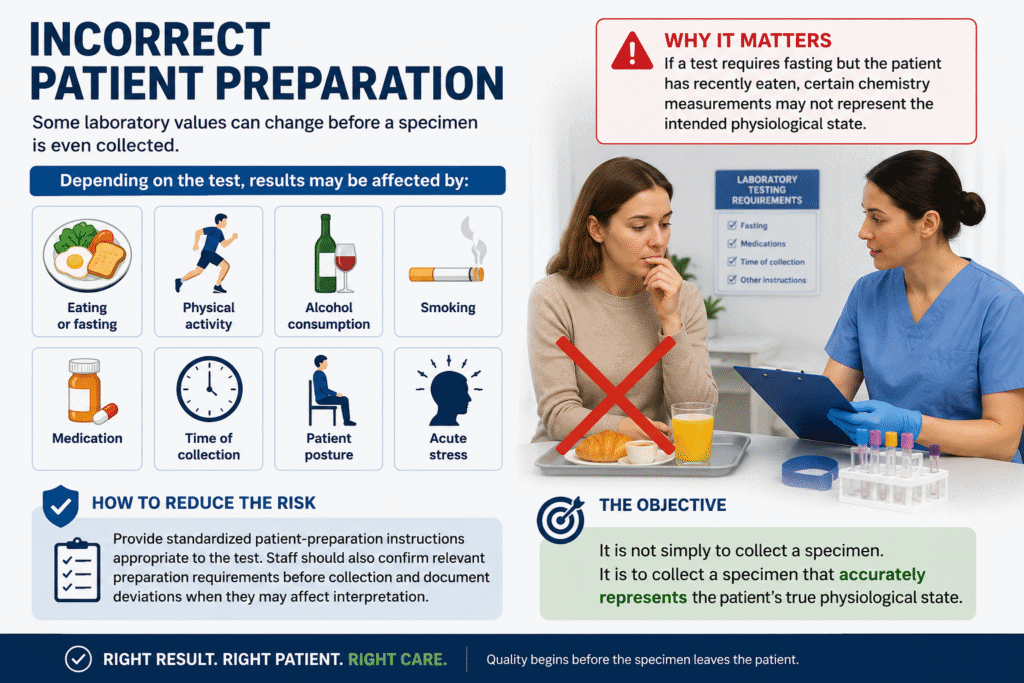
Some laboratory values can change before a specimen is even collected.
Depending on the test, results may be affected by:
If a test requires fasting but the patient has recently eaten, for example, certain chemistry measurements may not represent the intended physiological state.
How To Reduce The Risk
Provide standardized patient-preparation instructions appropriate to the test. Staff should also confirm relevant preparation requirements before collection and document deviations when they may affect interpretation.
The objective is not simply to collect a specimen. It is to collect a specimen that accurately represents what the requested test is intended to measure.
Specimen collection is one of the most vulnerable parts of the testing process because it involves multiple manual steps.
Common collection-related causes of laboratory test errors include:
These mistakes may alter the specimen itself or associate an otherwise accurate result with the wrong patient.
Why collection tubes matter
Different tubes contain specific additives such as anticoagulants, clot activators, or preservatives. Using an inappropriate tube can interfere with the requested assay.
For example, contamination by EDTA can affect measurements of certain electrolytes and enzymes. Laboratory teams should therefore treat tube selection and order of draw as quality-critical steps rather than routine details.
A sample can be correctly labeled and still be unsuitable for analysis.
Hemolysis occurs when red blood cells rupture and release intracellular contents into serum or plasma. Collection technique, excessive mechanical force, improper handling, and temperature conditions can contribute to in-vitro hemolysis.
Depending on the assay and degree of interference, hemolysis can alter laboratory measurements.
Other important specimen interferences include:
Lipemia: Excessive lipid particles can interfere with some analytical methods.
Icterus: High bilirubin concentrations can interfere with certain photometric assays.
Clotting: In specimens intended for anticoagulated testing, clot formation may make the sample unsuitable or produce unreliable measurements.
Laboratories should establish clear criteria for detecting, documenting, accepting, or rejecting compromised specimens according to the assay, instrument, and applicable procedures.
The quality of a specimen can continue changing after collection.
Temperature, time, light exposure, agitation, and delays in separating serum or plasma may affect analyte stability. This is particularly relevant when specimens travel from satellite clinics or collection sites to centralized laboratories.
For laboratories operating across geographically dispersed areas of the Philippines, transport conditions deserve particular attention.
Good specimen-management practices include:
A sample that arrives at the laboratory is not automatically a suitable sample. Its condition on arrival matters.
Once testing reaches the analytical phase, reagents become an important variable.
Expired, contaminated, incorrectly prepared, or improperly stored reagents can contribute to inaccurate results even when the analyzer itself is functioning normally.
Laboratories should pay attention to:
This issue can be particularly important in the Philippine climate because temperature-sensitive laboratory materials require appropriate storage and transport controls.
For a deeper discussion, see Understanding the Role of Reagent Quality in Test Accuracy.
Calibration establishes the relationship between an instrument's measurement response and known reference values. Quality control helps the laboratory monitor whether an analytical system continues to perform within acceptable limits.
Problems can occur when:
A QC result should not simply be treated as a box to tick before patient testing. Trends can provide early warning of deterioration before an analyzer produces obviously incorrect patient results.
Laboratories should define what happens when QC fails: investigate, correct the problem, verify acceptable performance, and only then proceed according to established procedures.
Laboratory instruments operate through precise mechanical, optical, fluidic, and electronic systems. Small performance changes can eventually affect reliability.
Potential equipment-related problems include:
Preventive maintenance helps identify these issues before they lead to downtime or unreliable results.
It should include routine operator maintenance as well as scheduled servicing according to manufacturer requirements.
For maintenance tips, read Laboratory Equipment Maintenance: Essential Tips for 2025
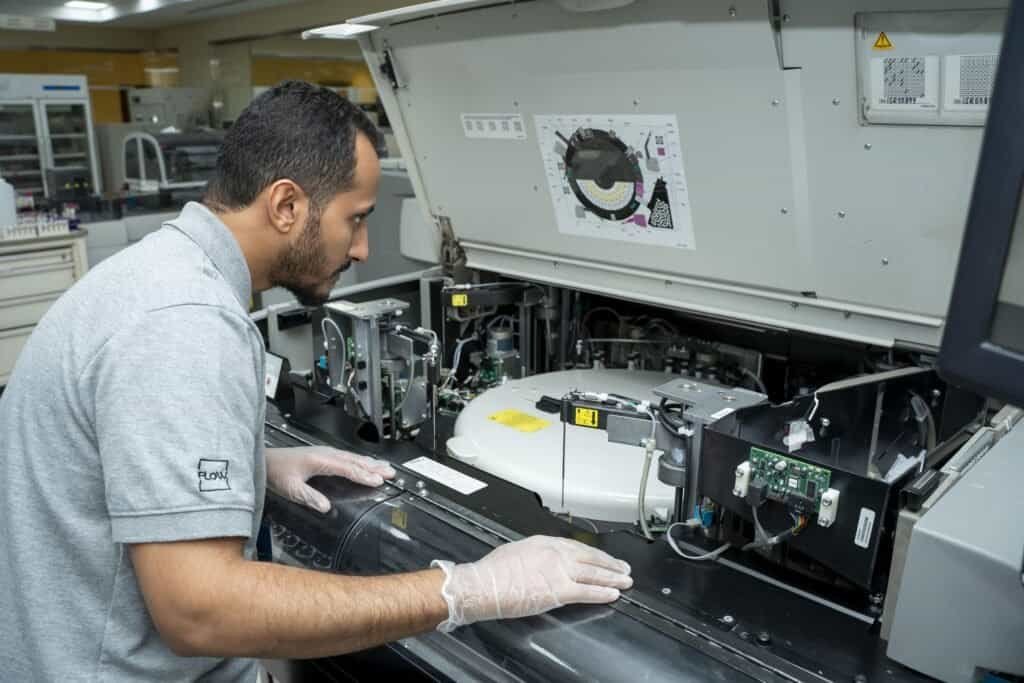
Automation has reduced many manual analytical steps, but people remain central to laboratory quality.
Human-related errors can include:
A 2024 review of pre-analytical errors noted that human factors remain a major contributor to such errors.
The solution is not simply “be more careful.” Laboratories need systems that make the correct procedure easier to follow.
That includes:
A strong quality system reduces dependence on memory and individual work habits.
A technically correct measurement can still become a clinical problem if the result is handled incorrectly after analysis.
Potential post-analytical errors include:
Automated transfer between analyzers and laboratory information systems can reduce manual transcription, but laboratories still need appropriate verification and reporting procedures.
This is why laboratory quality must cover the total testing process, not simply analyzer performance.
Automation can eliminate or standardize many repetitive manual steps, particularly during the analytical phase.
Automated analyzers may provide features such as:
However, automation does not make pre-analytical quality irrelevant. An analyzer can precisely measure a poor-quality or incorrectly identified specimen.
The best results come from combining appropriate technology with strong specimen-management procedures, trained personnel, quality control, and preventive maintenance.
For laboratories evaluating automated clinical chemistry, the BioSystems BA200 Clinical Chemistry Analyzer provides an example of a benchtop automated system. Biomedix lists the BA200 with barcode-dedicated reagents, 88 reagent/sample positions, automated dispensing, and throughput of up to 200 tests per hour.
Reducing lab test accuracy problems requires a system-wide approach.
Standardize pre-analytical procedures
Document requirements for patient preparation, collection, labeling, transportation, sample acceptance, and rejection.
Monitor quality indicators
Track metrics such as:
Tracking trends helps laboratories identify recurring problems rather than addressing each incident in isolation.
Strengthen quality control
Review QC data for trends and shifts, not only individual failures.
Maintain instruments proactively
Follow manufacturer recommendations for cleaning, calibration, preventive maintenance, and servicing.
Train and assess staff
Competency should be demonstrated periodically, particularly for specimen collection, analyzer operation, QC, troubleshooting, and result reporting.
Investigate errors instead of simply repeating tests
When something goes wrong, determine why. Root-cause analysis can prevent the same problem from recurring.
This system-based approach aligns with the broader principles behind ISO 15189:2022, the international standard specifying requirements for quality and competence in medical laboratories.
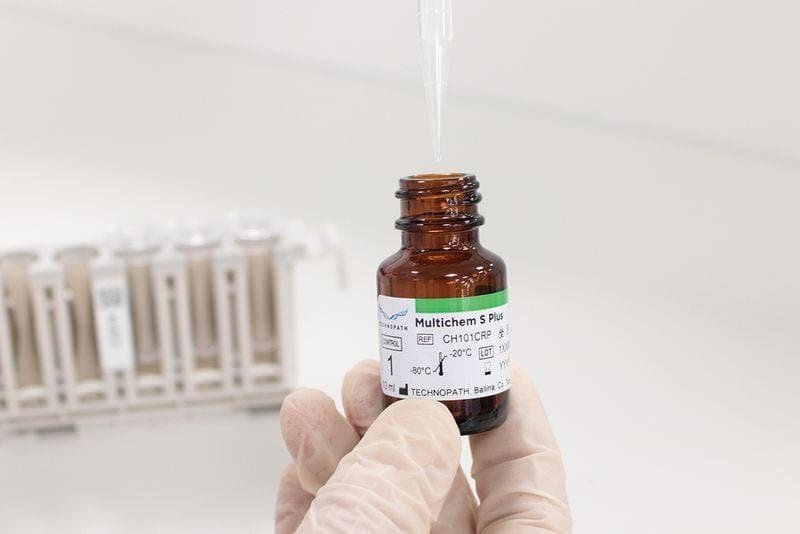
A result deserves additional review when it does not fit the expected analytical or clinical pattern.
Examples include:
The appropriate response depends on the test and laboratory procedure. It may involve reviewing specimen integrity, checking QC and calibration, repeating the measurement, requesting recollection, or communicating with the clinician.
The goal is not to make an unexpected result look “normal.” It is to determine whether the result accurately represents the patient's specimen.
What are the most common causes of laboratory test errors?
Common causes include improper patient preparation, specimen collection and labeling errors, hemolysis, incorrect storage or transport, reagent problems, calibration or QC failures, equipment issues, and reporting errors. Research consistently shows that many laboratory errors originate during the pre-analytical phase.
What is the most error-prone stage of laboratory testing?
The pre-analytical phase is generally the most error-prone. Published reviews estimate that roughly 60–70% of laboratory errors may occur before analysis, including during patient preparation, specimen collection, handling, and transportation.
Can an accurate analyzer produce an inaccurate result?
Yes. A properly functioning analyzer can still produce a misleading result if the specimen is compromised, the wrong sample is tested, reagents are unsuitable, or other pre-analytical or analytical conditions are not properly controlled.
How can laboratories reduce test errors?
Laboratories can reduce errors through standardized specimen procedures, staff competency programs, appropriate quality control, equipment maintenance, reagent management, automation where appropriate, and systematic monitoring of quality indicators.
How does quality control improve lab test accuracy?
Quality control helps laboratories detect changes in analytical performance before unreliable patient results are released. Reviewing QC trends, shifts, and failures allows staff to investigate potential reagent, calibration, or analyzer problems.
Does laboratory automation eliminate testing errors?
No. Automation can reduce manual handling and transcription errors, but it cannot eliminate problems such as incorrect patient preparation, poor specimen collection, unsuitable samples, or inappropriate test selection.
Lab test accuracy does not begin when a sample enters an analyzer. It begins with the test request and patient preparation and continues through specimen collection, transportation, analysis, verification, and reporting.
That is why addressing the causes of laboratory test errors requires more than purchasing accurate instruments.
Laboratories need reliable equipment, appropriate reagents, trained personnel, standardized procedures, effective quality control, and a culture that investigates errors instead of simply repeating tests.
By looking at the entire testing process, diagnostic laboratories can reduce lab test accuracy problems, minimize unnecessary repeat testing, and provide clinicians with results they can trust.
Ready to upgrade your lab test accuracy?
Review your laboratory workflow regularly to identify where small improvements can make the biggest difference.